







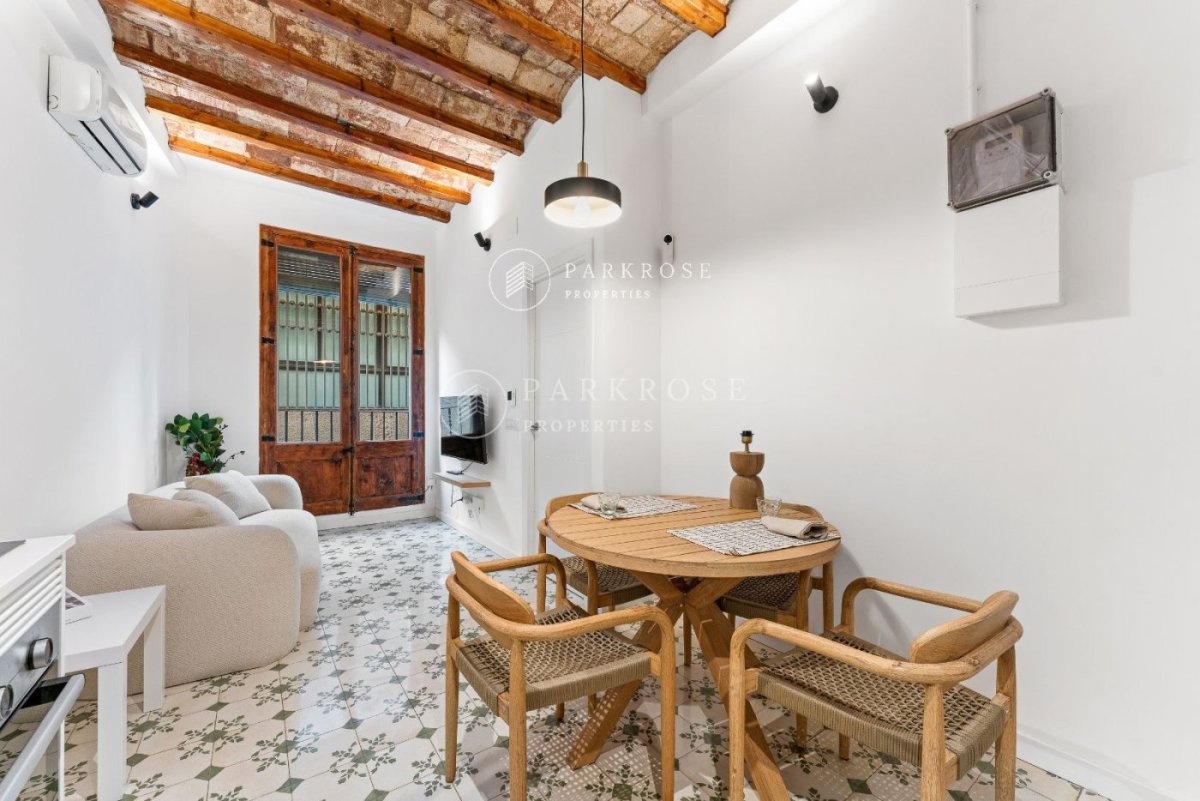
You’re weighing up a renovation before you sell, and you want to know if the price will rise by more than the works cost. We buy, renovate and resell flats in Barcelona ourselves, so we see both sides of that sum.
The averages are a useful start, but three things decide whether they apply to your flat.
How much more is a renovated flat worth in Barcelona?
A renovated flat in Barcelona carries an asking price 15% to 24% higher per m² than one needing renovation, in April 2026. Studios sit at the low end and four-plus-bedroom homes at the high end. The gap is gross: it compares listing prices and ignores the cost of the works.
Those figures come from idealista’s analysis of renovated versus unrenovated asking prices, published in April 2026.
Read them with four limits in mind:
They’re asking prices: they show what sellers ask, not what buyers end up paying.
The gap is gross: it doesn’t subtract the cost of the works, so it isn’t anyone’s profit.
“Good condition” and “needs renovation” are listing labels: they’re the category a flat is advertised under, not a technical survey of it.
Only the two ends of the range are published for Barcelona: studios at 15% and homes with four or more bedrooms at 24%; the sizes in between aren’t given, so we don’t estimate them.
Renovated flat do list for more in Barcelona. What matters to you as an owner is how much of that gap survives once the works are paid for.
Do you get back what the renovation cost when you sell?
A 2023 study by the valuation firm Gesvalt and the property investor Casavo puts numbers on that question for Barcelona:
A complete renovation adds about €1,161/ m² (+42%) over an unrenovated home. At a works cost of €600–650/ m² plus VAT, that leaves about €511/ m².
A partial renovation, with no structural changes, adds about €528/m² (+19%). At a works cost of €300–350/m², that leaves about €178/m².
Two caveats apply: these are estimated values, not sale prices; the works costs are an average of Madrid and Barcelona, not a Barcelona-only figure.
On those numbers, both kinds of renovation pay, and this is often what investors achieve. The values come from the two companies’ own transactions, and Casavo buys and renovates flats at scale.
Whether you get the same result depends on three things the averages hide:
What you paid for the flat.
The price ceiling of your area.
What you pay for the works.
For the third, see our guide to how much it costs to renovate a 70 m² flat.
None of these figures predicts what your own flat will sell for. The difference between an investor’s result and an owner’s comes down to the purchase price and the cost of the works. We explain how that works further down, under how property investors make a renovation pay.
Which renovations add the most value to a flat in Barcelona?
The three renovations that add the most value to a Barcelona flat are new floors, a new kitchen and a new bathroom, in no particular order; all three are visible from the first viewing. Hidden installations such as wiring and plumbing add less to the asking price.
In our experience buying and renovating flats in Barcelona, these are the three that move the price. We list them in no particular order:
Floors: the parquet or tiling underfoot in every room.
Kitchen: the units and the appliances.
Bathroom: the sanitaryware, shower, vanity unit and taps.
What they share is visibility: a buyer walking through the flat sees all three within minutes.
That’s also why a flat with a dated kitchen and worn floors gets listed as needing renovation, even when everything behind the walls is sound.
Why do visible changes raise the price more than new installations?
Buyers price what they can see.
On a viewing, they see the floors, the kitchen and the bathroom. They don’t see new wiring or new plumbing behind the walls.
So, in our experience, those installations add less to the price a buyer will offer. That doesn’t make them a waste of money; a flat may need them for its own sake. They’re simply a weak lever on price.
If your aim is a higher sale price, put your budget where the buyer will look first: floors, kitchen and bathroom.
When does a full renovation add more than targeted updates?
In most cases, we recommend targeted, visible updates rather than a full renovation.
A full renovation tends to pay in two situations:
The flat is in very poor condition – for example, inherited and not habitable as it stands.
It’s in a premium area where the market pays for the finish.
The Gesvalt figures above favour full renovation on average. But that’s investor data, drawn from companies that buy and renovate at scale.
Our advice to owners rests on the three variables instead: what you paid, your area’s ceiling and what the works will cost you.
If you’re still deciding whether to renovate before selling at all, settle that question first.
How do property investors make a renovation pay?
Property investors make a renovation pay through three levers: buying at or slightly below market value, doing the works at cost and keeping purchase, works and sale in one operation. ParkRose Properties targets a margin of around 10% on the total investment, including taxes and every other cost.
We buy, renovate and resell flats in Barcelona ourselves. We aim for around a 10% margin on the total investment: the purchase, the works, taxes and every other cost.
That works because of three things:
We buy at or slightly below market value.
We carry out the work ourselves, at cost.
Buying, renovating and selling happen under one roof, so many costs an owner pays to separate parties are absorbed in our own operation.
None of those levers is a shortcut. Each one lowers the cost side of the sum, and the margin depends on all three together.
Around 10% on everything we put in is a modest figure. It’s also a realistic one.
Can a homeowner expect the same return?
Not usually.
An owner who bought the flat at market value and pays full price for the works can’t assume the same margin. The purchase price is already fixed, and the renovation is bought in from a contractor.
That’s why we usually recommend targeted updates rather than a full renovation. A smaller, visible job keeps the cost side of the sum low.
The question to ask isn’t “how much will a renovation add?” It’s “how much will it add after I’ve paid for it?”
If you’d rather sell your flat in Barcelona as it stands or with light updates, we can talk you through both routes.
Is there a ceiling on how much a renovation can add?
The ceiling on what a renovation adds is the price buyers in the flat’s area will pay. Above that level, extra spending on works doesn’t lift the sale price. In September 2026, average asking prices across Barcelona’s districts ran from €3,318/ m² in Nou Barris to €7,211/ m² in Sarrià-Sant Gervasi.
Here’s an example we use with owners.
Say you bought a flat for €400,000 and spent €60,000 renovating it – you still can’t sell it for €500,000 if buyers in that area don’t pay €500,000.
Your district’s asking prices give a first sense of where that ceiling sits. The figures below come from idealista’s September 2026 price report.
Average asking price per m² by Barcelona district, September 2026
District and Average asking price (€/m²)
Sarrià-Sant Gervasi: 7,211 €/m²
Eixample: 6,648 €/m²
Les Corts: 6,635 €/m²
Gràcia: 5,654 €/m²
Sant Martí: 5,390 €/m²
Ciutat Vella: 4,850 €/m²
Sants-Montjuïc: 4,594 €/m²
Horta-Guinardó: 4,198 €/m²
Sant Andreu: 3,998 €/m²
Nou Barris: 3,318 €/m²
Barcelona (city): 5,462 €/m²
Source: idealista, September 2026 report (asking prices)
These are asking prices, and registered sale prices run lower. The Colegio de Registradores’ report for the second quarter of 2026 puts Barcelona city at €5,045/m².
idealista also refined its price methodology in July 2026 and recalculated its whole series, so its figures aren’t directly comparable with those it published before then.
Use the table to see where your district sits, not to price your own flat; your street, building and floor all move the figure.
Why does the price you paid for the flat matter?
If you bought expensively, even a spectacular renovation may not lift the price; you’ve already paid close to what the area will bear.
If you inherited the flat, or have owned it for 10 to 20 years, there’s usually more room.
That room is the space between what the flat cost you and what buyers in your area will pay. It’s the space a renovation can fill.
The same works can pay for one owner and lose money for another; the difference is the starting price.
Does a renovation raise the bank valuation?
A renovation can raise a flat’s bank valuation, because Spanish mortgage valuers compare the flat with similar properties and adjust for age and state of conservation, among other features. Each adjustment must be justified, and the rules set no fixed percentage for condition.
Mortgage valuations in Spain follow Orden ECO/805/2003, as amended, most recently in 2025.
Under the order, the valuer looks at comparable properties nearby. The valuer then adjusts for the ways your flat differs from them, including its age and its state of conservation.
The order sets no fixed percentage for condition. A renovation shows up in the valuation through that comparison, not as a set uplift.
How much will a bank lend against a renovated flat?
The mortgage on a renovated flat is tied directly to its bank valuation, which can differ from the agreed purchase price. For a main home, lenders normally finance no more than 80% of that valuation. A strong valuation supports the buyer’s mortgage.
The Banco de España’s guidance on mortgage valuations makes three points that matter when you sell:
The valuation can differ from the purchase price.
The mortgage amount is tied directly to the valuation.
For a main home, lenders normally finance no more than 80% of the valuation.
That 80% is normal practice, not a legal cap.
So a flat that values well supports the buyer’s mortgage.
Frequently asked questions
Does the energy rating change the sale price?
In our experience, buyers in Barcelona rarely weigh the energy rating when deciding what to pay for a flat.
Thinking of renovating before you sell?
Before you spend anything, let us value your flat free of charge. We’ll tell you which updates are worth making and which aren’t, and you’ll speak directly to our architect.
Article published 15/11/2026
Grupo inmobiliario especializado en la zona de Barcelona
En ParkRose Properties un servicio integral y personalizado para clientes que quieren comprar, vender, alquilar o reformar un inmueble. Nuestro equipo de expertos te informará de todos nuestros servicios y responderá a todas tus dudas.