







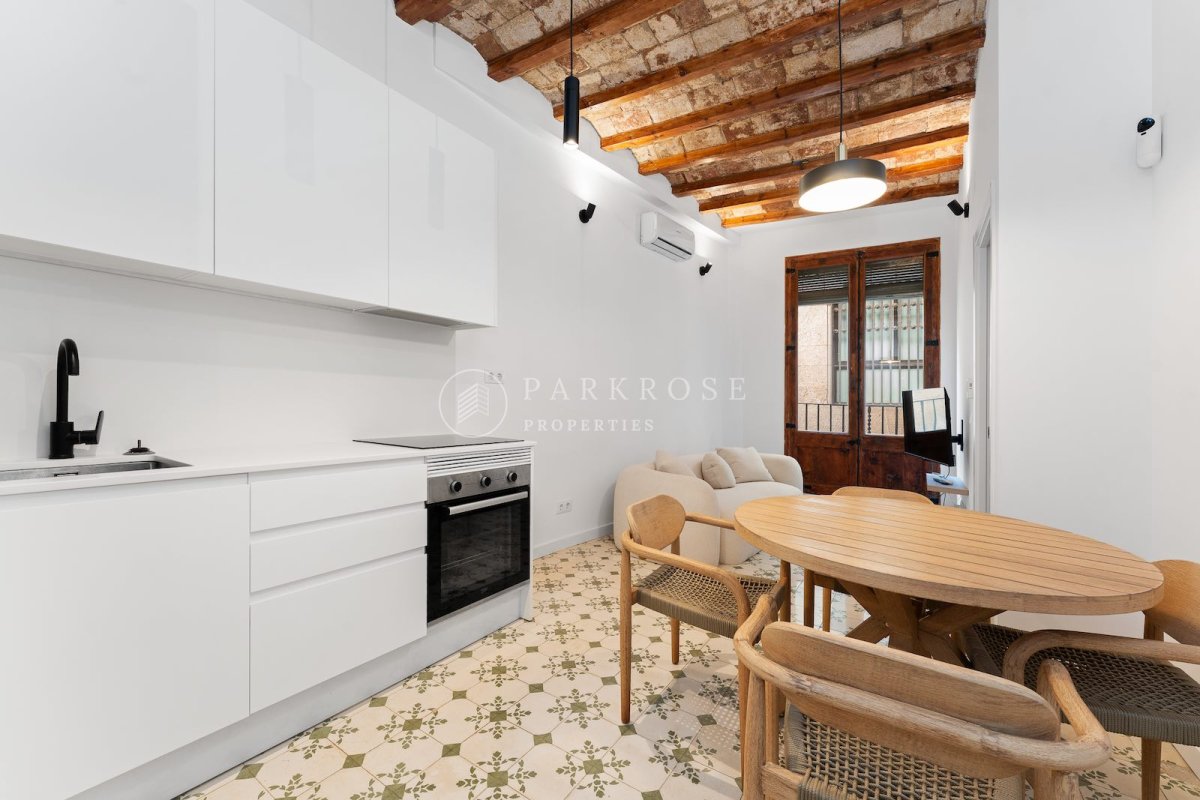
You want to sell your apartment and one doubt holds you back: do you renovate it first, or sell it as is? Getting into a construction project that you don't recover is as scary as selling below price. The good news is this: for your apartment, there is a clear answer.
What tips the scale boils down to five factors.
What does it depend on whether it is worth renovating before selling?
Whether a renovation is worth it is not decided by the work itself, but by the starting point of your apartment. Five factors weigh in: its condition, the area and its demand, the buyer profile, your budget, and the sale timeline. When they play in your favor, the renovation pays for itself. When they don't, it eats into your margin.
In Barcelona, apartments in good condition are listed between 15% and 24% higher than those that need renovation, depending on their size, according to an idealista analysis from April 2026.
Note: this is a difference between listing prices, not the net profit left after paying for the work. That range already tells you there isn't a fixed number. A studio and a large apartment do not appreciate the same way, nor do two different neighborhoods.
This decision is one more piece of your guide to selling an apartment in Barcelona.
Look at the five factors together below before requesting a single construction quote.
Property condition
What it means: Whether the apartment is already livable or has underlying defects
What to check: Dampness, electrical wiring, kitchen, and bathroom
Example: Electrical wiring from the 70s turns buyers away during the first visit
Location and demand
What it means: How much demand exists and what buyers expect from that area
What to check: Whether apartments in the area are sold renovated or as fixer-uppers
Example: In highly sought-after central neighborhoods, condition carries less weight in the price
Buyer profile
What it means: Who is buying on your street: home buyers or investors
What to check: Whether they are looking for move-in ready or want to renovate to their taste
Example: An investor pays for potential, not for your renovation
Available budget
What it means: How much you can invest without forced financing
What to check: Whether the renovation cost is recovered in the sale price
Example: Without a capped budget, renovation expenses eat into your profit
Selling timeframe
What it means: How long you can wait
What to check: Whether construction delays your market entry
Example: If you need to sell now, a full renovation is not the way
Does location influence whether renovation is worth it?
Location matters more than the work itself.
In a high-demand neighborhood, buyers discount less for property condition because location does most of the heavy lifting. In a low-demand area, even an expensive renovation does not guarantee recovering your investment.
An example from Barcelona's own market shows this clearly: a renovated 90 m² home in l'Antiga Esquerra de l'Eixample is listed for €549,000 (ref 1305), one of the city's most sought-after areas.
Before deciding, check how apartments on your street are selling: renovated or needing renovation.
Can you deduct renovation costs when selling?
Much of what you call "renovation" does not reduce your capital gains tax when selling.
Tax authorities only add capital investments and improvements to the acquisition value, excluding maintenance and repair expenses, according to the capital gains calculation rules of the Tax Agency.
Painting, replacing a boiler, or remodeling a kitchen fall under repair and maintenance. They do not reduce capital gains. Expanding square footage or genuinely structural/system upgrades do count as improvements. The burden of proof, via invoices, rests on you.
This is general information, not tax advice: consult a tax professional before selling.
Find complete details in our guide on costs and taxes when selling an apartment.
When is it worth renovating before selling?
Renovating is worth it when the apartment carries defects that slow down the sale: dampness, outdated wiring, or very old kitchens and bathrooms. In areas where buyers look for turnkey properties, a targeted renovation improves first impressions and reduces lowball offers.
Here are clear scenarios where renovation works in your favor:
Dampness or visible damage that scares buyers away.
Outdated electrical or plumbing systems.
Outdated kitchens and bathrooms in a market demanding "turnkey" properties.
A poor first impression: an apartment failing to get viewings.
The key is not renovating extensively, but renovating what buyers in your area value.
An example of renovation working in your favor: a property in Fort Pienc preserving modernist features in a historic 1925 building, presented turnkey and listed for €649,000 (ref 1283).
The goal is not renovating for its own sake, but ensuring the work matches local market expectations. Well-targeted apartment renovations in Barcelona present the home as a finished product and shorten negotiations.
What defects cause buyers to reject an apartment on the first visit?
Certain flaws end negotiations before they begin. Buyers overlook cosmetic flaws, but avoid anything hinting at major expense or trouble:
Damp stains
Old electrical breaker panel
Failing boiler
Unsanitary-looking bathroom
These issues trigger two reactions: buyers either walk away or lower their offer far beyond actual repair costs.
Fix unsettling flaws first; focus on decor later.
Is it worth improving energy certification before selling?
Energy performance certificates are required for listing an apartment, and buyers review them. Improving ratings through insulation, double-glazed windows, or efficient HVAC adds appeal. However, cosmetic updates alone will not raise energy ratings.
Replacing flooring and paint does not shift your rating letter.
Ratings improve when upgrading structural insulation or mechanical systems: windows, wall insulation, heating, and cooling. High-end cosmetic redesigns do not change energy ratings without upgrading those systems.
If your property carries a low rating against energy-efficient competitors, targeted upgrades set your listing apart.
When is it better to sell the apartment as is?
Selling as is makes sense when likely buyers are investors renovating to their specifications, when fast liquidity is needed, or when renovation costs exceed potential return. A priced-to-reflect fixer-upper directly attracts those buyers.
Renovations aren't always the primary driver of value.
The primary buyer is an investor renovating to custom specs.
You need fast liquidity and cannot front construction costs.
The expected value gain fails to cover renovation costs.
Your property fits as a priced-to-reflect fixer-upper.
Sometimes the main hurdle isn't finishes, but paperwork.
A renovated apartment in Nova Esquerra de l'Eixample is priced at €169,000 because the listing specifies it lacks an occupancy certificate (ref 1248). Here, administrative factors drive price, not finishes.
If your situation is similar, selling as is at an adjusted price outweighs undertaking construction. If speed is priority, you can also consider our direct home purchase in Barcelona without any renovations.
Who buys a fixer-upper apartment?
Certain buyers prefer untouched properties. Investors seek profit margins and tailor renovations to market demand for resale or rental. Individual buyers with a project want to choose every detail themselves without paying extra for choices they didn't make.
For both profiles, a well-located fixer-upper priced right is an opportunity, not a drawback.
Is it worth renovating an inherited or very old apartment before selling?
For inherited or severely outdated properties, pre-sale renovation rarely pays off unless you have time and capital to manage construction. Selling as a fixer-upper at an adjusted price usually yields better net results.
An apartment untouched for decades requires extensive work.
In inherited properties, required investment often comes at the worst time: multiple heirs, urgency to distribute proceeds, and little interest in overseeing contractors.
Before starting work, evaluate whether selling as is leaves you in a better position than tying up capital and time.
What mistakes do owners make when renovating to sell?
The costliest mistake is renovating to personal taste instead of appealing to the average buyer. Other frequent errors include over-renovating, adding premium finishes that mid-tier homes cannot recoup, and starting work without fixed-price quotes.
The pattern repeats: high capital outlay, minimal value recovery.
Choosing custom colors, bold materials, or unusual floor plans leads buyers to discount value to undo those choices. Similarly, installing luxury materials in mid-range homes rarely fetches proportional premiums.
Finally, commencing work without binding quotes leads to budget overruns, extended timelines, and eroded profit margins.
Renovate with your target buyer in mind, not as if you were moving in yourself.
Why does renovating to personal taste lower profit?
Your personal preferences belong to you, but buyers pay for their own vision.
Highly specific finishes, bold colors, or unconventional layouts narrow your pool of interested buyers. Fewer active buyers mean less upward pressure during negotiations.
Neutral choices aren't boring-they allow maximum prospects to picture themselves living there.
What alternatives exist to full renovation?
Before committing to full renovation, consider faster, cost-effective options: home staging, virtual home staging, cosmetic touch-ups with paint and lighting, or partial kitchen/bathroom updates. Each suits different property types and sales goals.
It isn't an all-or-nothing choice. There is plenty of middle ground.
Home staging - Furnishing and styling the apartment for viewings and photos, without construction.
Virtual home staging - Digitally rendering furnished or updated interiors in listing imagery.
Cosmetic touch-ups - Paint, improved lighting, and minor repairs that refresh appearance affordably.
Partial renovation - Updating key decision-making spaces like kitchens or bathrooms.
Start with the least invasive option that addresses your property's shortcomings. Escalate only if market conditions demand it.
When does home staging work better than a full renovation?
Home staging excels when the property is sound but presents poorly.
If the home is move-in ready but presentation lags (empty rooms, uninspiring photos, cold atmosphere), professional styling and photography transform buyer response at a fraction of renovation costs.
Renovations address tangible physical defects; staging addresses presentation and emotional appeal.
Frequently asked questions
What should be renovated first in an apartment?
Prioritize items that cause buyer hesitation over flashy cosmetics. Address hidden issues first: dampness, electrical panels, and plumbing. Next, focus on high-impact areas: kitchens and bathrooms. Paint and lighting come last as finishing touches that unify the space.
Does renovating help sell faster or at a higher price?
It impacts both to varying degrees. An appealing home generates higher viewing interest and sells quicker by reducing buyer hesitation, while also helping defend asking price against aggressive discounting. Price impact depends heavily on location, whereas marketing speed improvements are consistent across markets.
Renovate or sell as is? We help you analyze the numbers
Nicolás Akel, General Manager at ParkRose Properties and licensed real estate agent (API), has years of experience selling renovated and unrenovated homes across Barcelona. Two properties on the same street rarely call for identical strategies.
Before starting work, evaluate your property with professionals active in the market daily.
What's included:
No-obligation property valuation in Barcelona.
Analysis of which renovations make financial sense and which do not.
Fixed quote for renovation work should you choose to proceed.
Direct purchase option if you prefer selling without undertaking renovations.
Call us at +34 931 355 565, send a WhatsApp message, or request a home valuation.
Article published 12/10/2026
Grupo inmobiliario especializado en la zona de Barcelona
En ParkRose Properties un servicio integral y personalizado para clientes que quieren comprar, vender, alquilar o reformar un inmueble. Nuestro equipo de expertos te informará de todos nuestros servicios y responderá a todas tus dudas.